

Supporting a troubled teenager feels like steering a ship into the deepest waters without a compass.
Families dealing with their children’s trouble with adolescence or behaviour issues, substance misuse problems and/or mental health issues may all feel very much alone. Nevertheless, one remains optimistic owing to interventions programs that are especially designed to get the troubled youth moving in the right direction.
At-risk adolescents get the help they need through specialized programs. They create environments that includes therapeutic and education components that troubled adolescents are able to learn healthy coping skills, effective decision making and emotional stability.
In this guide, we’ll examine all the available programs for troubled youth, how they work, and their benefits and considerations so that parents can help find the best intervention.
Types of Programs for Troubled Youth
When searching for the right program for your troubled teen, understanding the different options available is crucial. Each program type offers unique benefits and approaches tailored to address specific issues that adolescents may be facing.
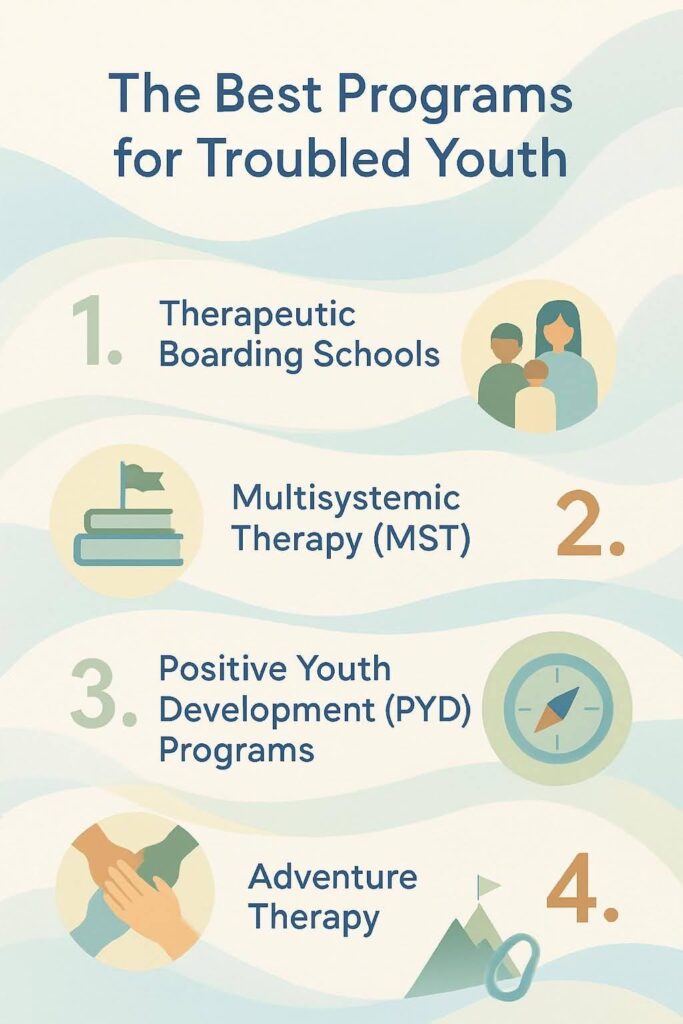
Therapeutic Boarding Schools
Structure and Environment
Therapeutic boarding schools help troubled teens which are one of the most effective options available.
Residential schools offer special needs therapy alongside education for children with disabilities. Therapeutic boarding schools are not standard boarding schools. Many of these centers employ licensed therapists and counselors who assist with educational staff. The primary consideration is the development of an individualized treatment plan for the student and a plan for the family.
Teens with behavioral problems benefit from receiving a boarding school therapy program that improves their chances of success in life. Teenagers at risk tend to feel more secure and confident when they have a scheduled and structured day. Some parents may choose other schooling that can benefit their adolescent. Many alternative schools offer a low student-staff ratio. Meaning each adolescent gets plenty of attention.
Benefits
Therapeutic boarding schools offer many benefits. At first, you will receive continuous therapeutic assistance in your daily life instead of weekly. You’ll get better results and a depth of healing you cannot get with in-office visits alone.
Additionally, these programs offer.
- Customized therapy discussions for addressing specific problems.
- Group therapy developing social skills and support system.
- Family therapy’s parts that cure and strengthen the family bond.
- Educational software that accommodates learning differences and builds academic confidence.
- Learn to be responsible and pick up vital life skills.
- Talent development activities offering healthy outlet for youth.
Many troubled teens find that the combination of therapy, education and structure can change the course of their life.
Considerations
Therapeutic boarding schools offer many advantages, but that doesn’t mean they are the answer to every situation. Many factors must be considered by parents.
- Therapeutic boarding school costs can be quite high. Most range between $5,000 and $10,000 per month with insurance covering some of the cost.
- Many programs take place in remote areas, making it difficult for families to attend.
- Your teen must stay 12 to 18 months at most therapeutic boarding schools to get results.
- Some schools are more behavior focused while others are more emotionally healing, insight development oriented.
Successful outcomes are most likely when there is a good match between the teen’s needs and the approach of the program. This means doing good research!
Multisystemic Therapy (MST)
Approach
Therapeutic boarding schools offer many advantages, but that doesn’t mean they are the answer to every situation. Many factors must be considered by parents. Therapeutic boarding school costs can be quite high. Most range between $5,000 and $10,000 per month with insurance covering some of the cost.
Many programs take place in remote areas, making it difficult for families to attend. Your teen must stay 12 to 18 months at most therapeutic boarding schools to get results.
Some schools are more behavior focused while others are more emotionally healing, insight development oriented. Successful outcomes are most likely when there is a good match between the teen’s needs and the approach of the program. This means doing good research!
Effectiveness
Evidence-Based Intervention for Troubled Youths Supported by Research Studies have demonstrated that MST can successfully.
- Reduce antisocial behavior and criminal activity.
- Decrease substance abuse rates.
- Improve family functioning and communication.
- Increase school attendance and performance.
- Reduce the need for out-of-home placements.
The program’s overall effectiveness lies in its multi-risk-factor approach that enhances the capability of the family system to foster wealth development.
Positive Youth Development (PYD) Programs
Philosophy
Positive Youth Development programs are based on a different worldview than deficit perspectives. PYD program isn’t problem-driven. It develops the strengths of the youth. Similarly, it focuses on creating positive relationships. Also aims at enhancing their ability to contribute.
The philosophy of Positive Youth Development (PYD) is based on the idea that every young people can develop positively with the right supports, opportunities, and relationships.
Implementation
Different locations house PYD programs like schools, community centers, after-school programs, and similar setups. They typically incorporate elements such as.
- Mentoring relationships with caring adults.
- Opportunities for leadership and meaningful contribution.
- Skill-building activities in communication, decision-making, and emotional regulation.
- Engagement in community service projects.
- Creative expression through arts, music, or athletics.
Instead of taking away teenagers from their environment, the programs aim to change that environment into a positively developing one.
Outcomes
Research on PYD programs shows promising results for troubled youth. Schools implementing comprehensive PYD approaches have documented:
- Reduced disciplinary incidents and suspensions
- Improved academic engagement and performance
- Enhanced social-emotional skills and peer relationships
- Greater community attachment and decreased antisocial behavior
- Improved overall school climate and safety
While PYD programs may not provide the intensive therapeutic support needed for youth with severe mental health issues, they offer valuable protective factors that can prevent problem behaviors from escalating.
Adventure Therapy
Methodology
Adventure therapy uses the power of outdoor activities to facilitate therapeutic insight and personal development and change behaviour. These wilderness expeditions, rock climbing, ropes courses, camping, and other activities use the natural consequences of our two great teachers.
The methodology behind adventure therapy is multifaceted.
- Physical challenges serve as metaphors for life challenges.
- Being in nature will distract you from unhealthy influences and distractions.
- Interpersonal skills and communication are learned through group experiences
- Success in overcoming obstacles help self efficacy and confidence
- Activities that reflect experience and personal growth
Activities that provide therapy can either include exercise such as mountain climbing, canoeing etc. and more days of camping out in nature. Unlike these, more long live theray is same but it sometimes combine adventure activities along with other traditional therapies also.
Benefits
Adventure therapy is great for resistant youth who may not respond well to conventional talk therapy. Research indicates that adventure therapy can.
- Enhance self-concept and self-confidence.
- Reduce symptoms of depression and anxiety.
- Improve impulse control and decision-making.
- Develop trust in self and others.
- Decrease recidivism rates among juvenile offenders.
- Create openness to therapeutic processes.
Some adolescents who cannot figure out their feelings in traditional therapy settings make breakthroughs amid the experience-focused adventure therapy practice that was previously unattainable in challenger ways.
Selecting the Right Program
With so many options available, choosing the right program for a troubled teen can feel overwhelming. However, a systematic approach to evaluation can help families make informed decisions.
Assessing Individual Needs
To choose the best program for your teenager, it is a good idea to conduct a thorough evaluation of your teen’s needs and problems. This evaluation should.
- Identify the primary issues driving problematic behavior.
- Check for any mental health diseases present that need treatment.
- Evaluate academic functioning and educational needs.
- Take a look at family dynamics that might be causing or being affected by the teen.
- Decide whether your intervention should be outpatient or another type.
Help by professionals with mental health backgrounds can help you with this task. Psychological testing, clinical interviews and collateral information from schools and other treatment providers are often included.
Accreditation and Licensing
When considering any program for troubled youth, you need to verify the proper accreditation and licensing. Programs should be able to provide documentation of.
- Licensing of residential facilities and educational programs by State.
- Recognition from acknowledged bodies including the Joint Commission and CARF (Commission on Accreditation of Rehabilitation Facilities).
- Accreditation awarded to academic programs having a syllabus.
- Staff member certification and licensing (e.g., therapists, teachers, and administrators)
The parents should also ask any complaints or history of regulatory violations. They should also ask about staff turnover rates. Stable staffing is typically a sign of quality programs.
Family Involvement
While programs differ in the extent to which family is involved, many family interventions are viewed as the most effective. When evaluating programs, consider.
- Family therapy sessions (in-person or virtual) opportunities.
- Parenting education modules that enhance capacities and knowledge
- We will keep you updated about your teen’s progress.
- Transition planning which prepares the teenager and family for reunification.
- Aftercare support to maintain gains for program graduates.
Interventions that see parents as part of the process tend to produce more lasting results than those that work just with teens alone.
Making the Decision
After gathering information about various program options, there are many factors to consider to make a decision.
- The program should fit with your teen’s specific needs.
- Your family’s values are aligned with the program.
- Have enough insurance and other resources in place.
- Location and logistics, like distance being a barrier to family involvement.
- Advisors from mental health experts who know your teen.
- Ask your teenager for input when it works to make them buy-in for the plan.
Often families turn to an educational consultant with experience in therapeutic placements for assistance. Expert consultants can help you evaluate all the options available to you based on your unique strengths.
Preparing for Intervention
When you pick a program, you’ll need to prepare yourself and your teen for the change. This preparation might include.
- Talk openly about what happens next (if it fits).
- Getting ready any needed documents, such as medical and school records.
- Familiarizing yourself with the programs unique intake procedures.
- Creating a plan for communication during the intervention.
- Developing a support network for parents and siblings during separation phase.
Don’t think of getting assistance for your troubled teenager as a reflection of your parenting. Rather, it’s a sign of strength. Many families find that intervention is a pivotal turning point not just our teen but for the family system.
The Next Steps
Struggling kids programs offer hope and help during some of families’ most challenging times. Through either the immersive environment of a therapeutic boarding school, the systemic approach of MST, the strength-based framework of PYD, or the experiential methodology of adventure therapy, there are many ways for troubled teens to heal and thrive.
Through appropriate support and intervention, troubled youth can experience a challenging journey that builds character and layers of resilience while progressing toward a fulfilling future. Evaluating needs, reviewing options, and choosing programs designed for your teen’s exact circumstances is a major step toward restoring hope to your family.
When your teenager is in serious trouble it has often gone on for a while, and the earlier you ask for help, the better. With the right program and help, troubled youth can turn their troubles into strengths to carry throughout their life.
Contact Help Your Teen Now to get specialized, qualified support





0 Comments